Tragedy Vs. Statistics
World War II killed 50 million people worldwide.
50 million.
It's hard to wrap your mind around a number like that - impossible to imagine that much death. Think about the terror and pain of one violent death, and then multiply that terror and pain by 50 million. Our minds balk at the attempt. So, instead, we turn the number, 50 million, into a cold statistic. We remove humanity from the inhuman number. Imagine this conversation:
“How many people died in World War II?”
“Oh, about 50 million or so.”
“Oh. That's awful. Let's get coffee.”
Our human capacity to quantify evil breaks down when the numbers of dead reach more than about 3,000. You can imagine 3,000 dead, murdered in New York on September 11, 2001. You can't imagine 50 million.
“One death is a tragedy. A million deaths is a statistic.”
That quote is normally attributed to Joseph Stalin, one of the most evil (evilest?) men ever to have lived, responsible for untold millions of murders and war deaths. (There is a special place in Hell reserved for Stalin and his ilk - Lenin, Mao, Hitler, Castro, Hussein, Bin Laden.) Stalin probably didn't say it - the attribution is in question. But if he didn't say that, he could have. Monsters like Stalin have a tendency to think in terms of millions of dead. One way to solve a problem of food shortage, for example, is to let 5 million people die of deliberately imposed starvation. One way to solve the “Jewish problem,” for another example, is to send 6 million Jews – mothers and fathers, husbands and wives, old grandmothers and little children - to the gas chambers, to be murdered, their naked, starved bodies bulldozed into large open trenches, covered with lime and bulldozed over.
The human capacity for evil is equaled only by the human ability to react to evil with compassion. Now there's a dichotomy that will keep you awake nights. How is it that a world so with so much atrocity can be so filled with mercy?
The destruction across Europe that was the result of World War II, and the concept of “total war,” was impossible to take in. The war in Germany was not a war of “liberation,” the purpose was not to “liberate” the German people from an occupying force. Instead, all of Germany was the enemy, it was made clear to allied troops that they were in enemy territory, and the approach to war against Germany was “total war.”
“ Germany will not be occupied for the purpose of liberation but as a defeated enemy nation,” said the Joint Chiefs, in a September 1944 directive to General Eisenhower. America 's intentions toward Germany were unambiguous: “Your aim is not oppression, but to prevent Germany from ever again becoming a threat to the peace of the world. Your occupation and administration will be just, but firm and distant. You will strongly discourage fraternization between Allied troops and the German officials and population.”
Much of the rest of Europe did not fare much better than Germany in terms of the destruction of cities, towns, infrastructure, transportation, distribution networks, the decimation of male populations, and the unprecedented mass-migration of “DPs,” displaced persons, a neat-and-clean word to describe the millions whose families, homes, livelihoods were shot and bombed out from under them, leaving behind drifting husks of wasted, human flotsam.
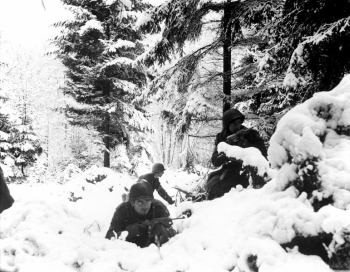
American Troops, Ardennes Forest, Belgium, Battle of the Bulge
Whole towns simply ceased to exist, the populations gone. The town of St. Vith in Belgium for example had been utterly destroyed during the fighting in 1944. When Belgian authorities arrived in February to survey the scene, they found not a single building left standing. “The area is completely empty of civilian inhabitants.” A town of 2,800 people had vanished. The safest place for a civilian Belgian was in a city or town occupied by the Allies. Any town that had been taken by the Germans was a target of relentless Allied bombing.
Even in war, forgiveness…
In pondering the dichotomy between the capacity for human compassion and the fact of unspeakable evil, the Belgian town of Houffalize grabs our attention. People, even victims in war, sometimes forgive the unforgivable.
Houffalize is a small town on the Ourthe River , smack-dab in the center of the “Bulge,” the German push Westward that was eventually cut off and destroyed the U.S. 2nd, 3rd and 11th Armored divisions as they broke through the Nazi stronghold here. Houffalize then became a linkup point for the 1st and 3rd Armies as they forced the Germans to retreat to the east. The Americans were spread too thin to keep Houffalize and instead moved south, on December 19, to defend Bastogne . The Germans filled that void on the next day, December 20, and even while the Germans were occupied by the greatest offensive (in the West) since 1940, they still found the time to arrest and interrogate civilians suspected of being involved in resistance activity. They ordered the mayor, Joseph Marechal, to round up all resistance members. He refused and fled for his life.
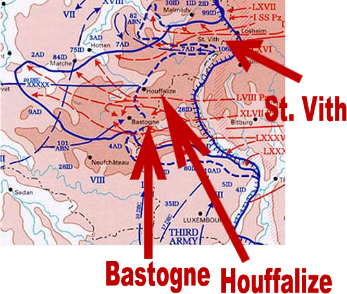
But the Germans carried out their searches anyway, and arrested, beat and murdered many citizens of that unhappy town. Six were shot on December 22 and 23, and two more were killed on Christmas Eve. On the 26 th , three more.
On Christmas Day death came not only from German atrocity but American aircraft of the Ninth Air Force. The bombing of Houffalize had begun - an effort to destroy the German armored units in the town. Between Christmas day and the 28 th , 38 civilians died in the bombings. The death and destruction from above would continue for the next 30 days.
When Belgian investigators arrived in Houffalize in late January to assess the damage, there were only 130 people still living there, out of a population of 1,325. Most of those were living hidden in the basement of the rectory - without food, heat, medicine or adequate clothing, scavenging for food, each expecting at any moment a German bullet or an American bomb.
Of the destruction of Houffalize, one reporter wrote, “One cannot say enough about how these people have suffered.” Hundreds of bodies lay unburied, all livestock had been butchered or killed in the bombings. Four shelters holding dozens of townspeople had taken direct bomb hits on January 6. The bodies lay unburied in the rubble for more than a month.
The destruction of Houffalize had been ordered by General Omar Bradley, who later lamented, in a moment of remarkable frankness, “Simple, poor, and unpretentious, the village had offended no one. Yet it was destroyed simply because it sat astride an undistinguished road junction.”
For the people of Houffalize death came with equal finality regardless of the source – A citizen of Houffalize killed in the bombings was just as dead as one shot for being a member of the resistance.
But 60 years later, the people of Houffalize could and did make the distinction between friend and foe, ally and enemy.
HOUFFALIZE, Belgium, Dec. 17, 2004 – Veterans of the Battle of the Bulge got a hero's welcome today from local residents who endured some of the most brutal fighting of the battle between U.S. and German troops here 60 years ago...
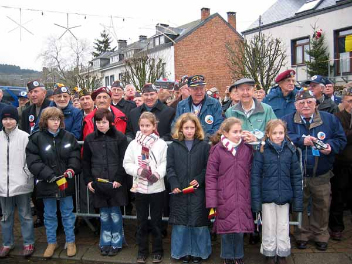
So begins an article from the Armed Forces Press Services on the happy reunion between the American veterans of the Battle of the Bulge and the citizens of Houffalize. 60 years after Houffalize had been destroyed in battles and by bombs, the citizens there applauded the American veterans of the battle who returned here for a reunion.
"We salute you and pay respect to our American friends," Mayor Jose Lutgen told the veterans during a reception following the ceremonies. He recalled "those terrible days" when Houffalize had reached what seemed like rock bottom, then to be freed "by young soldiers who landed in the midst of enemy fire."
"You all were heroes," Lutgen said. "And today, 60 years later, we welcome you again as the heroes who helped us retrieve our lost freedoms."
The people of this town had been oppressed and terrorized by the jack-booted, then they were freed, and they understood that liberation comes at a steep price, and because of that they can honor and praise their liberators.
Maybe the key to understanding and, possibly one day, avoiding war, is to take people one at a time, as individuals capable of feeling pain and loss, and to view each death as a tragedy, and to multiply that tragedy by the numbers involved to arrive at a much greater tragedy, rather than turning it into a cold statistic when it reaches some line of mental demarcation.
Get to the point, Lutz!
What does all this have to do with the Warriors' Watch?
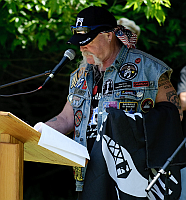
Well, not much. Only that when it comes to numbers, we are sometimes asked why we go to such lengths in welcoming home just one soldier. It happens time and again – an onlooker will see all the leather and denim and chrome and flags and signs and cheers, and that onlooker will say, “all this for just one soldier?”
The Warriors' Watch Vision Statement says that we envision a day in America when all troops will know that they are respected, honored, and welcomed home. It also says that we intend to bring about that day one soldier at a time.
At our inception that may have seemed like a pipe dream. After all, there are more than 1,400,000 people on active duty in the military, with an additional 848,000 people in the seven reserve components. That's a lot of welcomes home.
But take a look about you and compare attitudes today with those of the 70's, if you can remember the 70s. (You know what they say about those times – if you can remember the 60s and 70s, you weren't there.)
Honoring our troops, and even our veterans, has become fashionable again. It is no longer common, or even generally acceptable, to look down on uniformed men and women as something inferior. Vets, and especially active duty troops, are for the most part treated with honor and gratitude.
There are still far too many who simply don't think about our military men and women at all, one way or the other. But the general attitudes have absolutely changed, and I believe it is at least partially due to what you and I do every day – make loud, colorful displays of our respect for and honor of our troops. What we do is seen by many, and the stories of what we do fly around the world in this electronic age at the speed of light, and the attitudes change.
One soldier returning from war to a Hero's Welcome is a good thing. Tens of thousands of soldiers returning home to Hero's Welcomes is not just a statistic, it is the exponential result of one soldier at a time, done again and again and again.
Next Welcome Home you go to – look at that one soldier and see in him all that is good and noble about our American Armed Forces today as a whole. Take in our American Armed Forces today as a whole, and see the grand, end result of hundreds of thousands of individual American Soldiers, taken one at a time, as the men and women of noble character that they are.
It's all in the numbers.
American soldiers of the 290th Infantry Regiment 75th Division photographed in the Ardennes during the Battle of the Bulge.

 *This newsletter is named "The Weekly Ride" or "The Ride", for short, in memory of and to honor Sgt. Jennifer Hartman, U.S. Army. Sgt. Hartman was killed in Iraq by America's enemies. She died in defense of our freedom at the age of 20. This quote from Jennifer was read at her graveside:
"It's not about what happened in the past. It's not about what might happen in the future. It's about the ride, for Christ's sake."
Click here for a Tribute to Sgt. Jennifer Hartman: "The Ride"